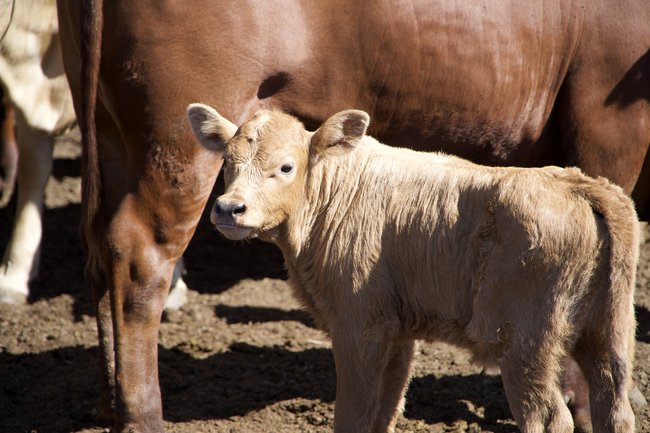
Red meat has a bad rap for its carbon footprint and impact on the land. But overcoming those challenges is a point of pride for the North Australian Pastoral Company (NAPCo).
NAPCo owns about 200,000 cattle at all stages of life on its six million hectares of land spanning across the Northern Territory and sweeping through western and southern Queensland.
That number of cattle would usually mean large amounts of methane production — the second largest contributor to global warming, largely created by cows during the digestive process — and a massive impact on the local ecosystem.
Know the news with the 7NEWS app: Download today
But NAPCo has implemented several projects to help limit the effects of raising cattle while also focusing on providing them a calm life from birth to processing.
One of the first steps was to breed a specific mix of cattle that would be more adept to survive on Australian land so land clearing isn’t required.
Further projects with the Universities of New England and Queensland led to breeding cattle which produce less methane, while also providing food which inhibits the production of the gas.
The company in 2024 also launched a partnership to open up its land to the Australian Wildlife Conservancy (AWC) for efforts to identify and protect endangered native wildlife.
At NAPCo’s Coolullah Station in western Queensland, manager Marty Doyle says the changes mean he’s able to focus more on the quality of life for the 11,000-odd cattle on the 220,000ha property — in itself larger than the island of Mauritius.
“You’re just managing a natural system, working with the environment, not against it,” he told 7NEWS.com.au.
“If I don’t look after the environment, I can’t look after my cattle.”


Doyle has been working with NAPCo for just under four decades and says the company’s approach goes against common misconceptions about agriculture, especially the use of harmful chemicals and land clearing.
“There might be, you know, a bit of land cleared to put a fence line through or a road through but that’s it … there hasn’t been any land clearing for stock grazing,” he said.
“It’s up to me to make sure that I manage my cattle so my pastures can also grow.”
Doyle said a number of technological advancements had been introduced to the industry which help the cattle stay healthy and happy.
But his day-to-day work is still mostly the same as it was when he first started back in the 1980s — getting up before sunrise and maintaining watering and feeding stations before the odd muster.
“I don’t think you’ll ever take the humanity out of the industry because, at some stage, cattle have to interact with humans,” he said.
“The technology is great but it’s certainly not a replacement for humanity.”


NAPCo natural capital manager Emma Baker said addressing the company’s environmental impact is “essential” to supplying beef.
“Those two things go hand-in-hand, if we’re looking after our land and we’re looking after our animals and producing a good quality meat product,” she said.
“We’re constantly trying to ensure we’re leaving the land in better condition than when we started.”
Baker said the approach has led to NAPCo reducing its carbon emissions by 43 per cent between 1981 and 2013, and was at odds with another misconception about the industry: that the staff simply “don’t care”.
“Caring for those animals and caring for our land is at the heart of what they do,” she said.
“They fundamentally love what they do, they love the country, they love the people and they love the cattle.”
That care for the country in particular helped lead the company toward a partnership with an “unusual bedfellow” in the AWC.


An unusual yet effective partnership
“They’re often seen as sort of polar opposites but they’re really not because we’re both trying to manage the land in a healthy and sustainable way,” AWC senior ecologist Rebecca Diete said.
“So, to me it makes sense we start working together in certain areas so we can achieve both those goals together.”
While the partnership is still in its infancy, Diete said they’ve already achieved some “massive wins” by finding several threatened species in areas previously unavailable to them.
Among them are marsupials, the bilby and kowari, and a quail-like bird called the plains-wanderer.
“A lot of people think that biodiversity is something that occurs in just national parks and things,” Diete said.
“No, it’s like we’ve built our entire human civilisation out of biodiversity and we really don’t know the full impact of when you start taking lots of species out of ecosystems.”